

Collaborative decision making isn't about meetings or consensus — it's about systematically extracting collective intelligence from diverse perspectives. When done right, groups beat individuals. When done wrong, you get groupthink and wasted time.
- 240 years of research (Condorcet to Google) proves the method works
- Psychological safety is the #1 predictor of team effectiveness
- The divergent→convergent model prevents both endless debate and premature consensus
- Know when NOT to collaborate — not every decision benefits from groups
The 240-Year-Old Proof That Groups Beat Individuals
In 1785, the Marquis de Condorcet proved something remarkable: if each member of a group has better than 50% chance of being right, the group's majority decision will be more accurate than any individual — and this accuracy approaches 100% as the group grows.
This isn't motivational fluff. It's a mathematical theorem. And it explains why collaborative decision making, when properly structured, consistently outperforms individual genius.
But there's a catch Condorcet also identified: if individual accuracy drops below 50%, larger groups become worse. This is why "wisdom of crowds" fails spectacularly when the crowd shares the same blind spots. Collaboration isn't magic — it's a tool that requires the right conditions.
The Research on Collaborative Decisions
Why Most Team Decisions Still Fail
If Condorcet was right, why do so many meetings end in frustration? Because most organizations violate the conditions that make collaboration work.
No Psychological Safety
When people fear judgment, they self-censor. The minority viewpoint that could prevent disaster never gets voiced. Harvard's Amy Edmondson showed this is the #1 failure mode — more common than lack of information or skill.
HiPPO Dominance
The Highest Paid Person's Opinion wins regardless of evidence. This violates Condorcet's requirement for independent judgments — when everyone defers to one voice, you've eliminated the diversity that makes groups smart.
System 1 Thinking Dominates
Kahneman's research shows we default to fast, intuitive System 1 thinking in social settings. Without structure forcing deliberate System 2 analysis, groups anchor on the first suggestion and stop exploring.
Wrong Phase, Wrong Mode
Teams converge too early (killing options before they're explored) or diverge forever (never reaching closure). Without explicit phase transitions, meetings oscillate randomly between exploration and evaluation.
The Divergent-Convergent Model
The Double Diamond, developed at the Design Council, reveals that effective collaboration has two distinct phases — and confusing them is fatal:
Phase 1: Divergent Thinking
Expand without judging. Gather all perspectives. Explore wild ideas. The goal is breadth, not consensus.
- • "What else might be true?"
- • "Who hasn't spoken yet?"
- • "What are we assuming?"
Phase 2: Convergent Thinking
Narrow to action. Evaluate evidence. Reach closure. The goal is decision, not continued exploration.
- • "Given the evidence, which option?"
- • "What's our confidence level?"
- • "Who disagrees and why?"
The critical insight: you must explicitly announce phase transitions. "We're now switching from brainstorming to evaluation." Without this, participants operate in different modes simultaneously — some still exploring while others are trying to close.
When NOT to Collaborate
Here's what most collaboration advocates won't tell you: not every decision benefits from groups. Sometimes a solo expert deciding in 10 minutes beats 5 people deliberating for an hour.
Skip Collaborative Decision Making When:
- Time pressure is extreme — Emergency decisions need a single decision-maker. The ER doctor doesn't convene a committee.
- Clear expert exists — If one person has 10x the relevant expertise, their judgment dominates regardless of process.
- No diversity gain — If all participants have identical information and perspectives, collaboration adds cost without benefit.
- Stakes are too low — Don't spend 5 person-hours deciding which coffee vendor to use.
The AI Augmentation Shift
The biggest change in collaborative decision making since Condorcet? AI. Not replacing human judgment — augmenting the cognitive infrastructure that makes collaboration exhausting.
AI can synthesize evidence from hundreds of sources that no human team could read. It can detect when discussion is dominated by a single voice. It can map the logical structure of arguments, revealing gaps and contradictions. It can even suggest devil's advocate positions when groupthink is emerging.
But here's what AI can't do: make the final call. Accountability remains with humans. The judgment of values, tradeoffs, and organizational priorities — that's ours. AI handles the cognitive load; we handle the decision.
"The future of decision-making isn't human vs. machine. It's human judgment augmented by machine intelligence, with clear accountability for both."
How Argumentree Structures Collaborative Decisions
Argumentree applies these research-backed principles to real team workflows. Instead of unstructured discussions that drift and lose context, every argument is mapped into a navigable tree — with evidence requirements, explicit support/oppose relationships, and traceable reasoning paths.
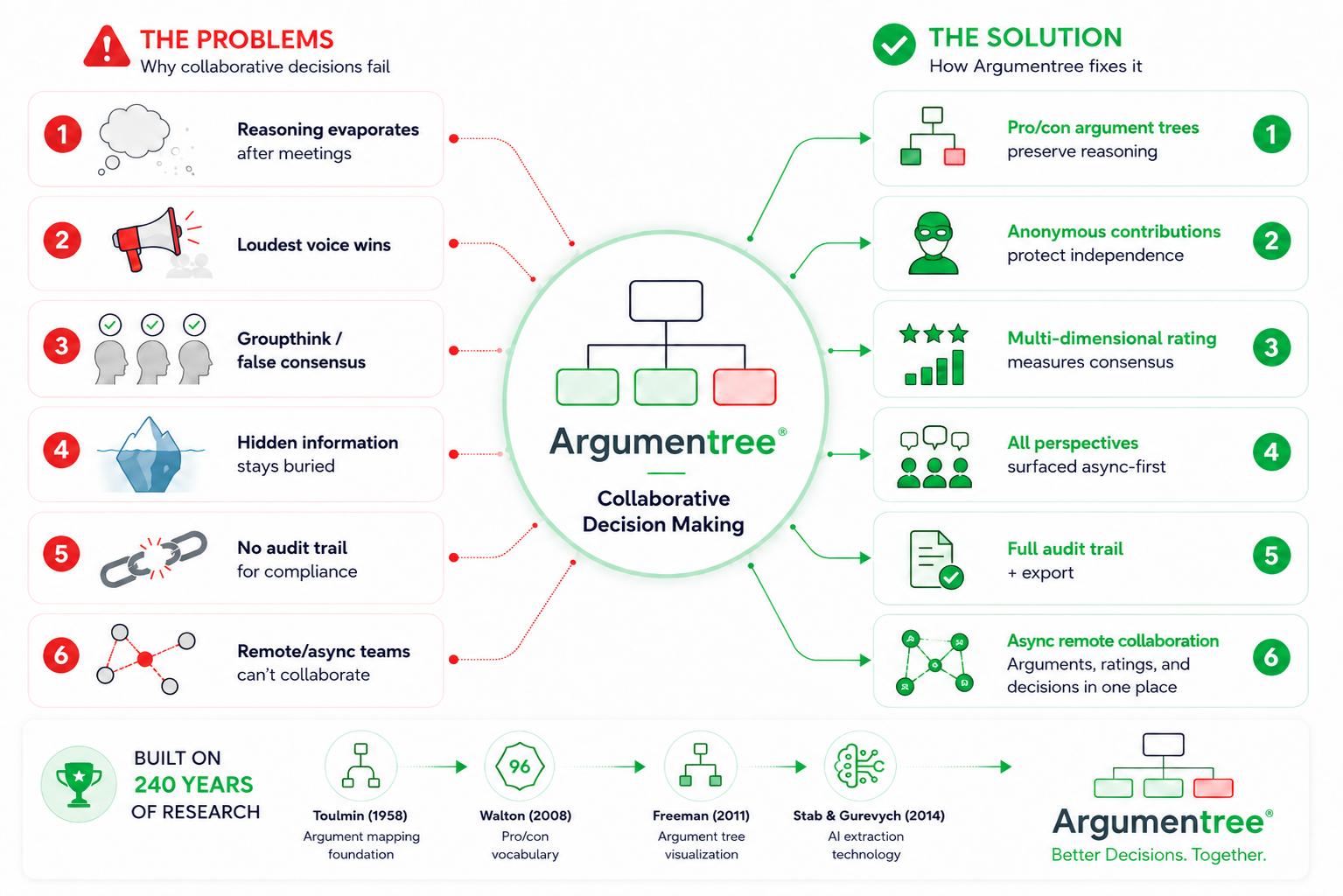
The result: teams can revisit why a decision was made, new members can understand the context without re-reading hundreds of messages, and AI augmentation helps surface gaps in reasoning before they become costly mistakes.
The Complete Guide
This post covers the essentials. For the comprehensive 5,000-word guide — including the full historical timeline from Condorcet to AI, detailed convergence techniques (Delphi, nominal group, dot voting), the complete list of cognitive biases that target groups, remote/async collaboration patterns, and implementation checklists — see our definitive resource:
What is Collaborative Decision Making?
The complete guide — from Condorcet (1785) to AI-augmented teams
Frequently Asked Questions
What is collaborative decision making?
Collaborative decision making is a structured process where multiple stakeholders contribute perspectives, expertise, and evidence to reach decisions that benefit from collective intelligence. It's not about voting or compromise — it's about systematically exploring all relevant viewpoints to find solutions that wouldn't emerge from individual thinking alone. Research dating back to Condorcet (1785) shows that groups can outperform individuals when diverse perspectives are properly aggregated.
When should teams NOT use collaborative decision making?
Not every decision benefits from collaboration. Skip it when: (1) time pressure is extreme — emergency decisions need a single decision-maker, (2) the decision is purely technical with one clear expert, (3) all participants have identical information and perspectives (no diversity gain), or (4) stakes are too low to justify coordination costs. A solo expert deciding in 10 minutes often beats 5 people deliberating for an hour on routine matters.
What is psychological safety and why does it matter for team decisions?
Psychological safety, defined by Harvard's Amy Edmondson, is the shared belief that a team is safe for interpersonal risk-taking. Google's Project Aristotle found it was the #1 predictor of high-performing teams — more important than who was on the team. Teams with high psychological safety are 76% more engaged and 27% more likely to report that team members share information. Without it, people self-censor, and the group loses access to minority viewpoints that could prevent catastrophic errors.
How do cognitive biases affect group decisions?
Several cognitive biases specifically target group settings: anchoring (first suggestion dominates), groupthink (conformity pressure), authority bias (deferring to seniority over evidence), and confirmation bias (seeking information that supports existing views). Kahneman's System 1/System 2 framework explains why: fast intuitive thinking (System 1) dominates in social settings where we want to avoid conflict. Structured frameworks that force explicit evidence and devil's advocacy can activate System 2 deliberation.
What is the divergent-convergent model of collaborative decisions?
The Double Diamond model shows that effective collaboration has two distinct phases: (1) Divergent thinking — expand options, gather perspectives, explore widely without judgment. (2) Convergent thinking — narrow to a decision using evidence, voting, or consensus techniques. Most teams fail by converging too early (shutting down exploration) or diverging forever (never deciding). The key is explicit phase transitions: 'We're now switching from exploration to evaluation.'
How does AI change collaborative decision making?
AI augments human collaboration in three ways: (1) information synthesis — AI can summarize evidence from hundreds of sources that no human could read, (2) bias detection — AI can flag when discussion is dominated by a single voice or when relevant perspectives are missing, (3) argument structuring — AI can map the logical relationships between arguments. But AI should inform, not replace, human judgment. The final decision accountability remains with humans; AI handles the cognitive load that makes collaboration exhausting.
Argumentree Team
Decision Science
The Argumentree team is pioneering structured decision intelligence for enterprises worldwide. Our mission is to transform how organizations make, document, and learn from decisions.
Structure your team's collaborative decisions. Try Argumentree free.
Turn unstructured discussions into navigable argument trees with evidence requirements and traceable outcomes.
Start Free 14-Day Trial